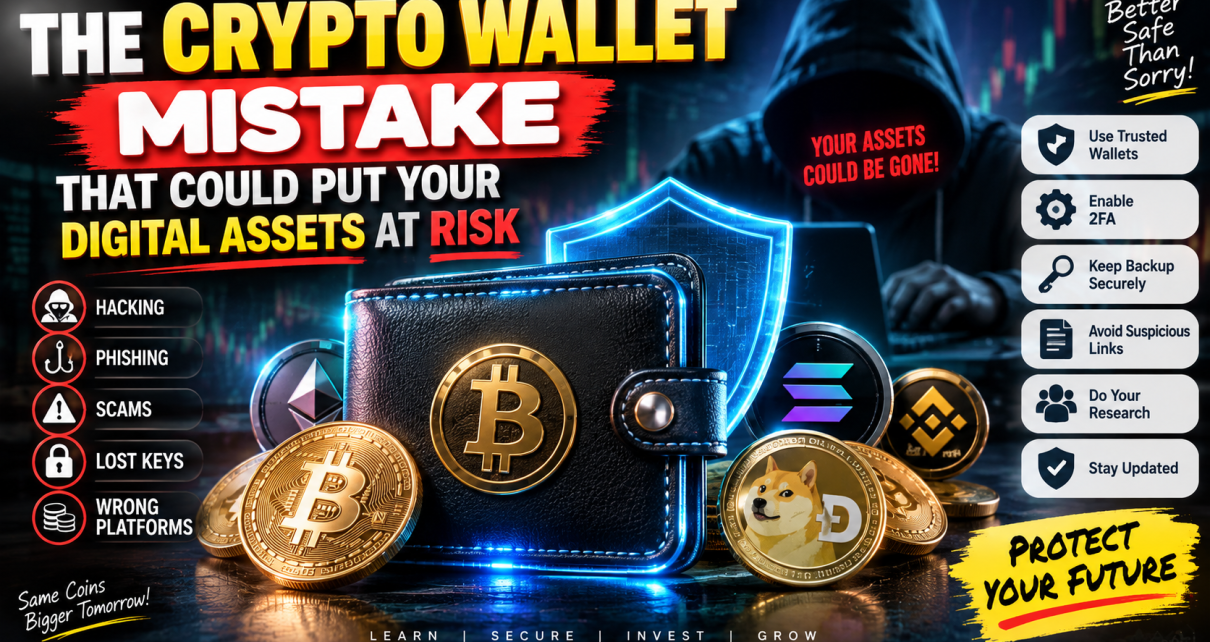
The Crypto Wallet Mistake That Could Put Your Digital Assets at Risk
Crypto wallets are often treated as simple tools for storing digital assets, but the wallet itself is only one part of the security equation. The way a wallet is selected, downloaded, used, and backed up can have a major impact on how well your cryptocurrency is protected.
One of the biggest mistakes crypto users can make is assuming that every wallet provides the same level of protection. A wallet connected to the internet has a different security profile from an offline hardware wallet. A self-custody wallet also works differently from an account where a third party controls the assets. Even a legitimate wallet can become risky if it is installed on a compromised device or purchased from an unreliable source.
Understanding these differences matters because cryptocurrency transactions generally depend on controlling the private keys or recovery information associated with a wallet. If that information is exposed, misplaced, or compromised, recovering the assets may become extremely difficult.
The most important wallet mistake is not simply choosing the “wrong” brand. It is misunderstanding where the real security risks are and assuming that the wallet itself will automatically protect you from every possible threat.
Understanding Crypto Wallet Security
Crypto wallets generally fall into several categories. They can be custodial or non-custodial, and they can use either hot or cold storage.
A custodial wallet means that another company, typically a centralized exchange, holds the cryptocurrency on your behalf. In this arrangement, you do not have complete control over the private keys yourself. If the exchange experiences an operational, security, or access problem, your ability to access your funds can also be affected.
A non-custodial wallet puts control of the assets in the user’s hands. As a result, the responsibility for protecting private keys and recovery information also shifts to the wallet owner.
This distinction is important because self-custody removes dependence on a third party, but it also removes the safety net of having someone else manage access. If you control your own wallet, you are also responsible for protecting it.
Hot Wallets vs. Cold Wallets
The other major distinction is between hot and cold storage.
A hot wallet is connected to the internet. Software wallets commonly operate as mobile applications or browser extensions. Their internet connectivity makes them convenient for regular transactions, interacting with decentralized applications, and managing digital assets.
However, that connectivity also creates additional exposure. Hot wallets can be affected by malware, phishing attacks, compromised devices, malicious websites, and other internet-based threats.
Cold storage keeps the information required to access cryptocurrency offline. Hardware wallets are a common example.
The basic security advantage is straightforward: information kept offline is less exposed to internet-based attacks. For someone planning to hold cryptocurrency for a longer period, keeping important assets in cold storage can therefore provide an additional layer of protection.
The Critical Mistake: Treating Convenience as Security
One of the most important lessons from the discussion of hardware wallets is that a higher price does not automatically mean greater security.
Modern hardware wallets can include touchscreens, Bluetooth connectivity, wireless charging, and other convenience features. These features can make a device easier or more enjoyable to use, but they do not necessarily make the underlying storage of private keys more secure.
The fundamental purpose of a hardware wallet is to keep private keys offline.
A simpler device may even have fewer features that introduce additional complexity. For example, Bluetooth connectivity can create another communication pathway that users may need to consider from a security perspective.
This does not mean that every device with Bluetooth is unsafe. The source material specifically notes that publicly available information, rather than private keys or recovery phrases, is transmitted through the Bluetooth functionality discussed. Nevertheless, additional connectivity can introduce considerations that simpler devices may not have.
The important principle is to distinguish between security features and convenience features instead of assuming that a premium price automatically provides superior protection.
Why the Device You Use Matters
A secure wallet cannot completely protect you if the computer or smartphone used to access it is compromised.
This is particularly important with software wallets. If a computer or phone contains malware or keylogging software, information entered into the device could potentially be exposed.
That means wallet security begins before the wallet application itself is opened.
Users should pay attention to the security of their operating system, keep their devices protected, and avoid installing suspicious software. A legitimate wallet running on a compromised device can still expose a user to serious risks.
This is why the security of the surrounding environment matters almost as much as the wallet’s reputation.
The Danger of Fake Wallet Applications
Another major mistake is downloading a wallet from the wrong source.
Users should be especially careful when searching for wallet applications because fake versions can appear in app stores or through sponsored placements.
A fraudulent wallet application can be far more dangerous than simply choosing a wallet with fewer features. If a user enters sensitive wallet information into a malicious application, the attacker may gain access to the information required to compromise the assets.
A safer approach is to obtain software directly from the wallet provider’s official website and verify that the application is legitimate before installing it.
For hardware wallets, the same principle applies even more strongly.
Why Buying a Hardware Wallet From an Untrusted Seller Is Risky
A hardware wallet is designed to protect private keys through offline storage, but the device itself must also be trustworthy.
The source recommends purchasing hardware wallets directly from the manufacturer rather than from third-party sellers. The reason is straightforward: a device obtained from an unreliable source could potentially have been tampered with before reaching the customer.
That creates a security problem that cannot necessarily be solved simply by using a hardware wallet.
The lesson is important: cold storage does not automatically mean secure storage. The entire chain—from purchasing the device to setting it up and protecting the recovery information—matters.
Do Not Put All Your Crypto in One Wallet
Another mistake is keeping every digital asset in a single wallet.
The source recommends spreading hot-storage holdings across multiple wallets rather than putting everything in one place.
The logic is similar to avoiding a single point of failure. If one wallet is compromised, the potential damage may be more limited when assets are distributed across different wallets.
Using different wallets for different purposes can also make sense.
For example, a hardware wallet may be used for long-term holdings, while a software wallet can be used for assets that need to be accessed more frequently.
However, diversification also increases the responsibility of keeping track of multiple wallets and their recovery information. Creating more wallets does not eliminate the need for careful security practices.
Hardware Wallets for Long-Term Holdings
The source places particular emphasis on hardware wallets for people who intend to hold cryptocurrency for a longer period.
The basic idea is that assets that do not need to be accessed frequently can benefit from being kept offline.
Among the hardware wallets discussed are Ledger and Trezor, with several models offering different combinations of price, connectivity, screen technology, security components, and supported assets.
One important consideration is whether the particular cryptocurrency you hold is supported before purchasing a wallet.
A wallet may have strong security characteristics but still be unsuitable for a particular portfolio if it does not support the assets you intend to hold.
Ledger Hardware Wallets
The source describes Ledger as one of the established manufacturers in the hardware wallet market, with models ranging from simpler USB-style devices to more premium models featuring larger displays and additional connectivity.
The Nano S Plus and Nano X are positioned as more affordable options. The Nano X adds features including iOS support and Bluetooth connectivity.
The higher-end Ledger Stax and Ledger Flex models focus more heavily on convenience and display features.
The important point is that more expensive models do not automatically provide dramatically colder storage. Their additional cost is largely associated with features and convenience rather than simply increasing the fundamental benefit of offline private-key storage.
For users who value simplicity and discretion, the smaller Nano-style design may also have practical advantages.
Trezor and the Open-Source Approach
Trezor takes a different approach, with a strong emphasis on open-source software.
Open-source code allows the wider community to inspect the software and identify potential problems. The source presents this transparency as an important distinction between Trezor and wallets using proprietary systems.
Trezor also offers Shamir Backup on supported models. This allows a recovery seed to be divided into multiple shares, with a predetermined number of shares required to recover the wallet.
For example, a recovery arrangement can be divided into several parts while requiring only a specific threshold to reconstruct access. This can provide additional flexibility when planning recovery and protecting against the loss or compromise of a single share.
However, wallet support is another consideration. Different hardware wallets support different numbers of cryptocurrencies, so users should always verify compatibility before making a purchase.
Software Wallets Have a Different Role
Hardware wallets are not the only option.
Software wallets are widely used because they are convenient, generally easy to access, and suitable for frequent transactions.
The source discusses several software wallets, including Exodus, Trust Wallet, Phantom, and Coinbase Wallet.
Each has different features, supported assets, blockchain compatibility, and approaches to security and usability.
The key point is that software wallets should not automatically be treated as equivalent to hardware wallets simply because they come from well-known companies.
A hot wallet remains connected to an internet-enabled environment, so the security of the device and the user’s behavior remain critical.
Exodus
Exodus is presented as a long-established software wallet with a focus on simplicity and user experience.
The wallet supports a large number of assets and provides functions such as buying, selling, swapping, and staking.
However, convenience can also come with costs. The source notes that buying, selling, and swapping cryptocurrency directly inside a wallet can involve additional fees compared with using other platforms.
From a security perspective, Exodus is described as having a long history without a known wallet hack, exploit, or vulnerability. At the same time, the source notes that its code is only partially open source and that it does not use traditional third-party two-factor authentication in the same way as some services.
The wallet instead has an approach that can integrate with supported hardware devices for additional security.
Trust Wallet
Trust Wallet is another major software wallet discussed in the source.
Its open-source nature allows its code to be inspected publicly, while its broad blockchain and asset support makes it useful for users managing different types of cryptocurrency.
The wallet is designed around accessibility and convenience, including mobile and browser-based access.
Its broad support can be useful for users with diversified crypto portfolios, but the same fundamental rule still applies: a software wallet is only as secure as the environment in which it is being used.
Phantom
Phantom began as a wallet strongly associated with the Solana ecosystem and later expanded its capabilities.
Its interface is designed for speed and accessibility, and it supports features such as token swapping and ecosystem updates.
The source also highlights the importance of being careful with airdrop-related links.
Fake airdrops and malicious links can be used to trick users into interacting with fraudulent websites or applications. Because of this, users should not automatically trust links shared through social media simply because they appear to offer free cryptocurrency.
Verified information from the wallet’s legitimate ecosystem is safer to rely on than random links.
Coinbase Wallet
Coinbase Wallet is another self-custody wallet discussed in the source.
It supports multiple major networks and provides mobile and browser-based access. It also integrates conveniently with the Coinbase ecosystem, which can make transfers between a Coinbase account and the wallet easier for users already familiar with the platform.
The wallet also includes security features such as biometric protection and two-factor authentication, while supported devices can use secure hardware components.
However, the source makes an important distinction between Coinbase Wallet and newer smart-wallet technology. These should not automatically be treated as the same product or security model.
The Biggest Security Lesson
The most important lesson is that choosing a recognizable wallet is only the beginning.
Security depends on several interconnected decisions:
Where you obtain the wallet.
Whether the wallet is custodial or non-custodial.
Whether the assets are stored hot or cold.
How secure the phone or computer is.
How private keys and recovery information are protected.
Whether you interact with unknown links.
Whether you spread your holdings across multiple wallets.
Whether the hardware device came directly from a trustworthy source.
Ignoring any one of these areas can weaken an otherwise strong security setup.
A wallet does not remove the responsibility of the person using it.
Why Recovery Information Must Be Treated Seriously
Self-custody gives users greater control, but that control comes with responsibility.
The recovery information associated with a wallet is fundamental to regaining access if the original device is lost or damaged.
This makes recovery information something that should never be casually exposed or stored in insecure locations.
The security model of a self-custody wallet depends heavily on keeping sensitive access information away from attackers while also ensuring that the legitimate owner can recover the wallet when necessary.
This is one area where convenience and security can come into conflict. Making access extremely easy can sometimes introduce additional exposure, while adding layers of protection may require more careful management.
The goal is not simply to make a wallet complicated. The goal is to understand what information actually controls access and protect it accordingly.
The Right Wallet Depends on How You Use Crypto
There is no single wallet that is ideal for every situation.
Someone holding cryptocurrency for years may prioritize offline storage and simplicity.
Someone frequently interacting with decentralized applications may prioritize software-wallet compatibility and convenience.
Someone holding many different assets may prioritize broad blockchain support.
Someone already using a particular ecosystem may value seamless integration.
The source therefore emphasizes looking beyond price and appearance. A premium touchscreen hardware wallet may be more enjoyable to use, but a less expensive device can still provide the fundamental benefit of keeping private keys offline.
Likewise, a software wallet with a polished interface does not eliminate the risks associated with internet-connected storage.
The goal should be to match the wallet’s characteristics to the way the assets will actually be used.
Final Thoughts
The crypto wallet mistake that could put your digital assets at risk is not necessarily choosing one particular wallet over another. The deeper mistake is assuming that owning a wallet automatically makes cryptocurrency safe.
Security depends on the entire process.
Use legitimate wallet software obtained from the appropriate source. Purchase hardware wallets directly from the manufacturer when possible. Keep long-term holdings in appropriate offline storage. Be cautious with internet-connected wallets and the devices used to access them. Avoid suspicious links and fake applications. Consider spreading assets across multiple wallets instead of creating one massive point of failure.
Most importantly, understand the difference between convenience and security.
A hardware wallet does not need to be the most expensive model to provide its fundamental benefit. A software wallet does not become risk-free simply because it is popular. And a wallet downloaded from an unverified source can undermine the security advantages you expected it to provide.
Crypto gives users significant control over their assets, but that control comes with responsibility. The safer approach is to understand how custody, storage, devices, applications, and recovery mechanisms work together before trusting any wallet with valuable digital assets.
