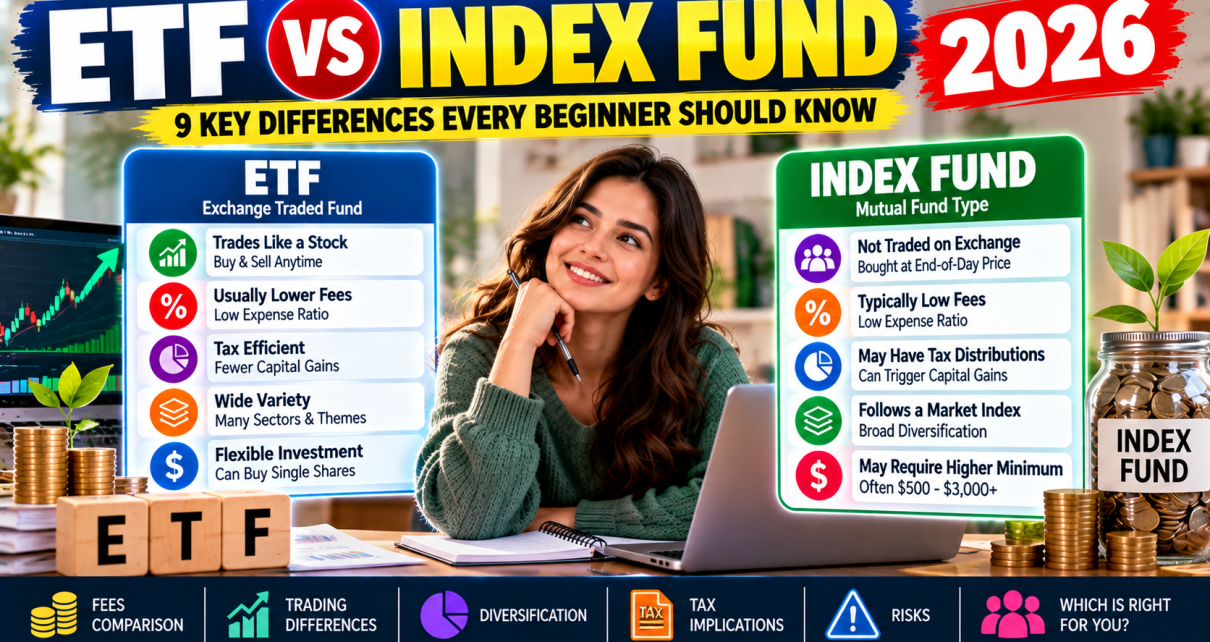
ETF vs Index Fund 2026: 9 Key Differences Every Beginner Should Know
Investing can seem complicated when you first encounter terms such as ETFs, index funds, mutual funds, expense ratios, market indexes, and diversification.
One of the most common sources of confusion is the difference between an ETF and an index fund.
You will often hear people use these terms almost interchangeably. That happens because many ETFs and traditional index funds can own very similar investments and can be designed to follow the same underlying market index.
But they are not exactly the same thing.
The biggest differences often come down to how they trade, how you buy them, minimum investment requirements, and how they fit into an investment strategy.
For beginners, understanding these differences can make it easier to choose an investment approach that matches their goals and preferences.
An index fund is generally designed to passively track a specific market index rather than rely on a professional manager to select individual investments in an attempt to outperform the market.
An ETF, or exchange-traded fund, can also follow an index and use the same type of passive investment approach. The key difference is that an ETF trades on an exchange throughout the trading day, much like an individual stock.
That means two investments can provide very similar market exposure while still having different ways of being bought and sold.
Here are nine key differences every beginner should understand before deciding between an ETF and an index fund.
- ETF and Index Fund Refer to Different Things
The first thing to understand is that “ETF” and “index fund” are not necessarily opposite investment categories.
An index fund describes an investment approach: the fund attempts to track a particular market index rather than having a manager constantly select investments in an effort to beat the market.
An ETF describes a fund structure that trades on an exchange.
This means an ETF can be an index fund.
For example, an ETF can be designed to track the S&P 500. It can hold a collection of large U.S. companies and attempt to follow the performance of that index.
A traditional index mutual fund can also be designed to track the S&P 500.
The investment strategy can therefore be very similar.
The major distinction is how the fund is bought and sold.
This is why beginners should be careful when comparing the terms.
Instead of thinking:
ETF versus index fund
it can be more useful to think:
ETF versus traditional index mutual fund.
Once you understand that distinction, the rest becomes much easier.
Both can provide diversification and passive exposure to a broad group of investments without requiring you to individually research and purchase hundreds of companies.
- ETFs Trade Throughout the Day
One of the clearest differences is how the investments trade.
Traditional index funds typically trade once per day at the market’s closing value.
ETFs, on the other hand, trade throughout the trading day like stocks.
This creates a different experience for investors.
If you own an ETF, its market price can move during the day as investors buy and sell shares.
You can place an order during market hours and the transaction occurs through the market.
A traditional index mutual fund works differently. Instead of continuously trading throughout the day, purchases and sales are processed based on the fund’s daily value.
For a long-term investor who contributes regularly and rarely pays attention to intraday price movements, this difference may not matter much.
But it is still important to understand.
The trading structure can influence how you interact with the investment.
ETFs can feel more similar to buying individual stocks because they are traded during the day.
Traditional index funds can feel more like a set-and-contribute investment because transactions are based on the fund’s daily pricing.
Neither structure automatically makes an investment better.
They simply provide different ways to access an investment strategy.
- ETFs Can Offer More Trading Flexibility
Because ETFs trade throughout the day, they provide greater flexibility in when you buy or sell.
An investor can see the ETF’s market price during the trading session and place an order accordingly.
This is one of the characteristics that makes ETFs attractive to investors who want the trading experience associated with exchange-listed securities.
Traditional index funds are less focused on intraday trading.
They are generally more straightforward for investors who simply want to contribute money and own a diversified portfolio without worrying about the market price every minute.
For a long-term beginner, this distinction should be considered in context.
If your strategy is to invest regularly and hold for many years, you may not need intraday flexibility.
In fact, constantly watching prices can sometimes make investing feel more complicated than necessary.
The source emphasizes that the difficult part of long-term investing is not necessarily finding the perfect fund. Consistency is a major part of the process.
That means the trading flexibility of an ETF should be viewed as a feature, not as a reason to trade constantly.
- Minimum Investment Requirements Can Differ
Another difference highlighted in the source is the minimum investment required to purchase certain traditional index funds.
Some traditional index funds can require a minimum investment, such as $3,000.
That can be a barrier for a beginner who is just starting to invest.
An ETF version may provide an alternative because ETFs can be purchased as individual market-traded shares.
This can make it easier for someone with a smaller amount of money to gain exposure to a particular investment strategy.
The difference can be particularly relevant when comparing similar funds.
Suppose you want exposure to a broad group of U.S. companies but do not have enough money to meet the minimum investment of a particular traditional index fund.
An ETF that provides similar market exposure could potentially give you another way to begin.
However, minimum investment requirements depend on the specific fund and brokerage arrangement.
You should always check the current terms before investing.
The broader lesson for beginners is simple:
Do not assume that you need thousands of dollars before you can begin investing.
Look at the available ETF and index-fund structures and understand their respective requirements.
- Both Can Provide Broad Diversification
One of the biggest advantages of index-based investing is diversification.
Instead of trying to identify one or two companies that will perform well, an index fund can provide exposure to a broad collection of companies through a single investment.
The source describes this concept as effectively buying the whole group rather than trying to identify individual winners.
That can make diversification much easier for a beginner.
For example, a broad U.S. stock market fund can contain thousands of companies.
The source discusses the Vanguard Total Stock Market approach, which provides exposure to large companies, mid-sized companies, and smaller businesses across the U.S. market.
Similarly, an S&P 500 fund provides exposure to hundreds of large U.S. companies.
An ETF can provide the same type of broad exposure when it tracks the corresponding index.
This is an important reason that ETFs and index funds can sometimes appear almost identical from an investment perspective.
If both funds are tracking the same underlying index, the stocks inside them may be very similar.
The structure may differ, but the underlying market exposure can be closely related.
- Both Can Use Passive Investing
Another important similarity is passive management.
Instead of relying on a professional manager to constantly choose stocks in an attempt to beat the market, an index fund generally follows a predetermined index.
An ETF can use the same passive approach.
This can simplify investing.
Rather than trying to determine which individual company will outperform next year, an investor can gain exposure to a broad group of companies and allow the investment to follow the underlying index.
The source emphasizes the low-cost nature of this approach compared with actively managed strategies.
Because there is less ongoing decision-making involved in selecting individual stocks, passive funds can often operate with relatively low expenses.
For beginners, this is an important concept.
You do not necessarily need to predict which company will become the next major winner.
Instead, a broad index-based investment can allow you to participate in the performance of a large collection of companies.
The objective is generally to follow the market represented by the index rather than constantly trying to outsmart it.
- Costs Can Be Very Low
Cost is another important consideration when comparing ETFs and index funds.
The source repeatedly emphasizes the low-cost nature of index investing and gives examples of funds with extremely low expense ratios.
For example, the source describes funds with expense ratios around 0.03%.
At that level, the annual expense associated with $10,000 invested would be approximately $3, assuming the stated expense ratio remains applicable.
The important lesson is not that every ETF or index fund costs exactly the same.
They do not.
The lesson is that investors should pay attention to expenses.
A fund’s expense ratio represents an ongoing cost associated with owning the fund.
Even a small percentage can become meaningful over long periods because your investment may remain invested for many years.
This is particularly relevant for a long-term investing strategy.
If two investments provide similar market exposure, comparing their costs can help you understand the difference between them.
Low-cost investing is one of the central ideas emphasized in the source.
But cost should not be considered in isolation.
You should also understand what the fund tracks, how diversified it is, its investment structure, and whether it fits your overall strategy.
- The Underlying Index Matters More Than the Label
A common beginner mistake is to focus too heavily on whether an investment is an ETF or an index fund while ignoring what the investment actually owns.
The underlying index matters.
Two funds can both be ETFs but have completely different investment strategies.
One might track large U.S. companies.
Another might focus on value stocks.
Another could track a broader collection of companies.
Similarly, two traditional index funds can track different indexes and therefore provide different exposure.
The source discusses several examples of different approaches.
An S&P 500 fund focuses on large U.S. companies.
A total stock market fund provides broader exposure across the U.S. market, including large, mid-sized, and smaller companies.
A value-oriented fund focuses on established companies that are characterized by the source as slower-growing and more stable.
A balanced fund can combine stocks and bonds while also providing international exposure.
Therefore, the label alone does not tell you enough.
Before investing, ask:
What index does this fund track?
What types of companies does it own?
How broad is the exposure?
Is it focused on a particular investment style?
Does it include international investments?
Does it include bonds?
Understanding the underlying portfolio is more important than simply choosing something because the word “ETF” or “index fund” appears in its name.
- The Best Choice Depends on How You Want to Invest
The final difference is really about how the investment fits into your personal investing process.
An ETF may appeal to someone who wants the flexibility of buying and selling throughout the trading day.
A traditional index fund may appeal to someone who prefers a simple long-term contribution strategy.
For many beginners, both approaches can provide diversified market exposure without requiring constant stock selection.
The important thing is to understand your own investing behavior.
If you want to automate regular contributions and hold investments for many years, a traditional index fund may provide the straightforward experience you are looking for.
If you prefer the flexibility of exchange-traded investments, an ETF may fit your approach better.
The source repeatedly returns to the importance of consistency.
Whether an investor chooses an S&P 500 approach or a total-market approach, the long-term process of investing consistently can be more important than constantly searching for the perfect fund.
That is especially relevant for beginners.
Investing can become counterproductive when every market movement creates a reason to change strategy.
A simple, diversified, low-cost investment approach can be easier to maintain over time.
ETF vs Index Fund: A Simple Comparison
For beginners, the differences can be summarized this way.
An index fund is an investment strategy designed to track a specific market index.
An ETF is a fund structure that trades on an exchange throughout the day.
A traditional index fund generally processes transactions once per day based on its daily value.
An ETF can be bought and sold during market hours.
Some traditional index funds may have minimum investment requirements.
ETFs can provide an alternative way to access similar market exposure without the same type of fund minimum.
Both can be passively managed.
Both can provide broad diversification.
Both can have very low expenses, depending on the specific fund.
The underlying index remains one of the most important factors to examine.
Examples of Index-Based Investment Approaches
The source provides several examples that demonstrate how different index-based strategies can work.
An S&P 500 fund focuses on approximately 500 large U.S. companies.
The source highlights VOO as an ETF tracking the S&P 500 and identifies FXAIX as a Fidelity version of the same broad S&P 500 approach.
A total stock market strategy provides broader exposure.
The source discusses VTI and VTSAX at Vanguard and FSKAX at Fidelity as examples of total U.S. stock market funds.
The source describes the total market approach as holding thousands of stocks, including large companies, mid-sized businesses, and smaller companies.
A value-focused approach is another possibility.
The source highlights VTV, the Vanguard Value ETF, which focuses on established companies and is described as having around 300 holdings.
A balanced approach can combine different asset classes.
The source discusses VASGX as a growth-oriented balanced fund with an 80% stock and 20% bond allocation and exposure to both U.S. and international markets.
These examples demonstrate why investors should look beyond the ETF-versus-index-fund label.
The investment strategy underneath the fund can make a much bigger difference to the portfolio’s exposure.
How Beginners Can Compare an ETF and an Index Fund
If you are comparing two investments, start with the underlying index.
Then look at the fund’s holdings and diversification.
Next, compare the expense ratio.
After that, check whether there is a minimum investment requirement.
Understand how the fund trades.
Finally, consider whether the structure fits the way you plan to invest.
For example, if two funds provide similar exposure to the same market segment, but one has a higher cost or a minimum investment that does not fit your budget, those differences may matter.
On the other hand, if you are focused on long-term investing and both options provide similar exposure at a low cost, the structural difference may be less important than you initially think.
The goal is not to make the decision unnecessarily complicated.
It is to understand what you are buying.
Why Diversification Matters for Beginners
Diversification is one of the strongest concepts behind broad index investing.
Instead of depending on the performance of one company, you can spread exposure across many companies.
The source gives the example of a total stock market fund holding thousands of companies.
That means the portfolio can include large corporations as well as smaller businesses.
If a smaller company grows dramatically in the future, a broad total-market investor may already have some exposure to it.
Likewise, if one company performs poorly, its impact can be smaller than it would be in a portfolio concentrated in only a few stocks.
Diversification does not eliminate investment risk.
Markets can still fall, and broad stock-market investments can experience significant declines.
But diversification can reduce the dependence on the success or failure of a single company.
That is one reason broad index-based strategies are often appealing to long-term investors.
The Importance of Staying Consistent
Choosing between an ETF and an index fund is only one part of investing.
The source emphasizes that consistency is one of the most important aspects of a long-term strategy.
Investors can spend enormous amounts of time searching for the perfect fund, but the ability to continue investing through different market conditions can be equally important.
Markets will rise.
Markets will fall.
Some sectors will perform better than others.
Economic conditions will change.
A long-term investor therefore needs a strategy that is practical enough to maintain.
Automating contributions can make consistent investing easier because it reduces the need to make a fresh decision every time you receive income.
The objective is not to predict every market movement.
It is to build a repeatable investing process.
Final Thoughts
ETF vs index fund is not necessarily a battle between two completely different investment strategies.
In many cases, the two can provide very similar market exposure.
The biggest distinction is often the structure.
Traditional index funds generally trade once per day, while ETFs trade throughout the day like stocks.
Some traditional index funds may require a minimum investment, while ETFs can provide another way to access similar exposure with fewer barriers to getting started.
Both can use passive investment strategies.
Both can provide diversification.
Both can have low costs.
And both can be useful tools for long-term investors.
For beginners, the most important lesson is to look beyond the label.
Understand what the fund owns.
Understand which index it follows.
Check the expense ratio.
Look at minimum investment requirements.
Understand how it trades.
Then decide whether the investment fits the way you want to build and maintain your portfolio.
The source’s broader message is also worth remembering: successful long-term investing is not necessarily about finding a fund that will make you rich quickly.
It is about choosing a sensible strategy, investing consistently, maintaining diversification, and giving your investments time to work.
Whether you ultimately use an ETF, a traditional index fund, or a combination of both, understanding the differences can help you make more informed investment decisions.
