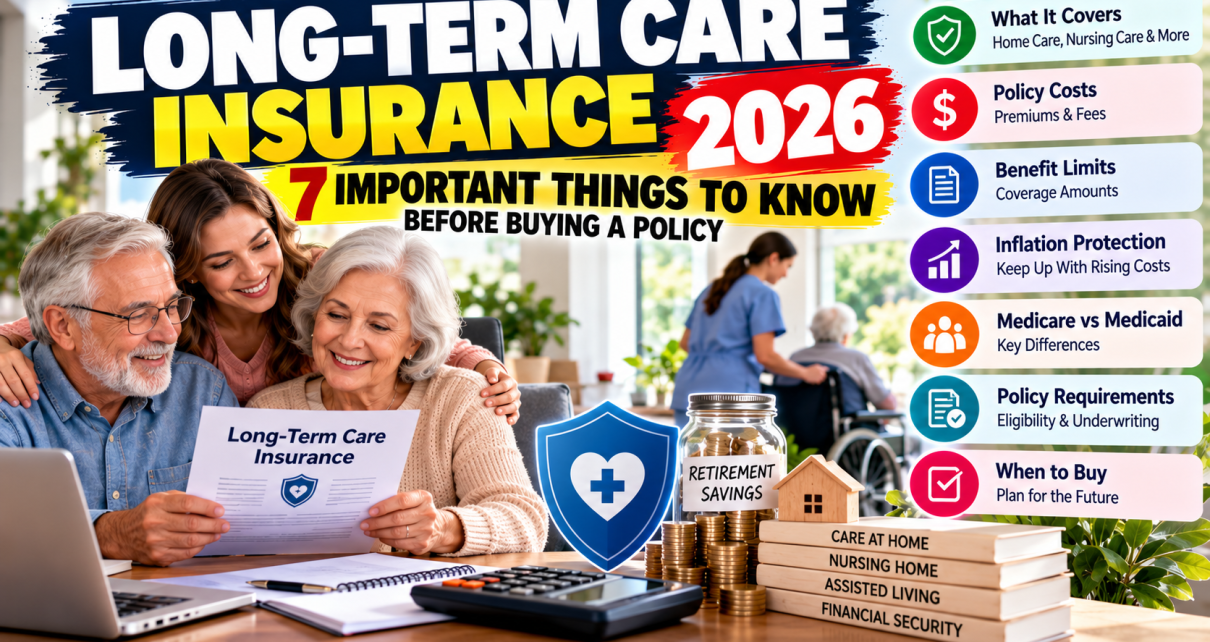
Long-Term Care Insurance 2026: 7 Important Things to Know Before Buying a Policy
Planning for retirement is usually focused on building savings, managing investments, paying off debt, and creating enough income to support your lifestyle. But there is another financial risk that can significantly affect retirement: the cost of long-term care.
A person may spend decades building retirement savings only to face substantial expenses if they eventually need ongoing assistance with everyday activities. Nursing homes, assisted living facilities, home care, and other forms of extended care can create significant financial pressure for individuals and families.
This is where long-term care insurance comes into the picture.
Long-term care insurance is designed to help pay for certain types of extended care when a person can no longer perform everyday activities independently. Depending on the policy, coverage may include services such as nursing home care, assisted living, home health care, adult daycare, certain caregiver services, and some hospice-related support.
However, long-term care insurance is not automatically the right choice for everyone. Policies differ in their benefits, premiums, eligibility requirements, waiting periods, inflation protection, and coverage limitations.
Before buying a policy, it is important to understand how this type of insurance works and how it fits into your broader retirement plan.
Here are seven important things to know before purchasing long-term care insurance in 2026.
- Understand What Long-Term Care Insurance Actually Covers
Long-term care insurance is designed to help cover the cost of extended care when someone can no longer manage certain everyday activities independently.
This is different from traditional health insurance.
Traditional health insurance generally focuses on medical treatment, diagnosis, and healthcare services. Long-term care insurance focuses more on the ongoing assistance a person may need when they require help with daily living and extended care.
Depending on the specific policy, long-term care insurance may help pay for several different types of services.
These can include nursing home care, assisted living, home health care, adult daycare, certain caregiver services, and some hospice-related support.
The exact coverage depends on the policy and insurer.
This distinction is important because long-term care does not necessarily mean living permanently in a nursing home.
A person may eventually need assistance while remaining at home. Another person may need assisted living or a nursing facility. Someone else may require a different form of professional or caregiver support.
A long-term care policy can potentially provide financial support for eligible services, depending on its terms.
That flexibility can be valuable because people have different preferences about where and how they want to receive care.
Some may strongly prefer to remain at home for as long as possible. Others may eventually need a professional care facility.
When evaluating a policy, therefore, do not focus only on the headline benefit amount. Look carefully at the types of care that qualify for coverage.
Ask:
What types of care are covered?
Can benefits be used for care at home?
Does the policy cover assisted living?
Does it cover nursing home care?
Are caregiver services included?
Are there restrictions on where services can be received?
Understanding these details before buying the policy can help prevent unpleasant surprises later.
- Long-Term Care Can Become a Major Retirement Expense
One of the biggest reasons long-term care deserves attention in retirement planning is its potential financial impact.
The uploaded source emphasizes that long-term care can become one of the largest expenses during retirement. Nursing home care, assisted living, and even in-home care can cost thousands of dollars per month.
When these expenses continue over an extended period, the financial impact can become substantial.
For someone who has spent decades accumulating retirement savings, a prolonged period of care can put considerable pressure on those assets.
Without advance planning, a person may have to use retirement savings or other financial resources to cover care-related expenses.
This can affect more than the person receiving care.
Family members may also become involved financially or physically. Some families rely on relatives to provide care, while others may need to hire professional caregivers.
Long-term care planning is therefore not simply an insurance decision. It can also be part of a broader retirement and family financial plan.
A policy that provides financial support for eligible long-term care expenses may help preserve some assets and provide more flexibility when care becomes necessary.
However, insurance should not be viewed as a guarantee that every future expense will be covered.
Coverage depends on the policy.
The more important lesson is to recognize the risk early enough to include it in your retirement planning.
Retirement planning is often based on expected expenses. Long-term care represents a potentially significant expense that may be difficult to predict in advance.
Planning for that possibility can reduce financial uncertainty.
- Medicare Should Not Be Assumed to Pay for Everything
One of the most important points in the source is the warning against assuming that Medicare will pay for all long-term care.
This misunderstanding can create serious problems for retirement planning.
People often associate Medicare with healthcare coverage and may therefore assume that long-term care expenses will automatically be covered.
However, the source specifically emphasizes that Medicare’s long-term care coverage is limited and depends on specific circumstances.
That means you should not build a retirement plan around the assumption that Medicare will cover every future long-term care expense.
Instead, understand the distinction between medical care and ongoing long-term care.
A person can have medical insurance and still face expenses associated with extended assistance, caregiving, assisted living, nursing care, or other long-term services.
This is why long-term care deserves its own place in retirement planning.
Before purchasing a policy, it is worth understanding what your existing insurance arrangements may and may not cover.
You should also read the actual terms of any long-term care insurance policy rather than relying on general assumptions about insurance coverage.
The key question is not simply:
“Do I have Medicare?”
It is:
“What financial resources and insurance coverage would be available if I eventually needed extended long-term care?”
That question provides a much more useful starting point for retirement planning.
- Consider Your Age, Health, Assets, and Family Situation
Long-term care insurance is not exclusively for people who are already retired.
The source suggests that people in their 50s and early 60s may want to consider whether this type of coverage fits their circumstances.
However, there is no single age that automatically makes buying a policy appropriate.
Your health, financial situation, retirement savings, investments, home ownership, and personal preferences all matter.
For example, someone who has accumulated meaningful retirement assets may be particularly interested in strategies that could help protect those assets from future care costs.
Someone else may place greater importance on having more choices regarding where care is received.
Another person may be primarily concerned about avoiding complete dependence on family members.
These are personal financial considerations rather than universal rules.
The source identifies several situations in which someone may consider long-term care insurance.
You may want to evaluate it if you:
Are in your 50s or early 60s
Own a home
Have retirement savings or investments
Want to protect assets
Prefer not to rely entirely on family members for future care
Want more options if long-term care becomes necessary
Your health can also affect the decision.
The source points out that eligibility and premiums often depend on age and health at the time of application.
This makes timing an important consideration.
Waiting until significant health problems develop may affect your ability to qualify or the cost of coverage available to you.
That does not mean everyone should immediately purchase a policy at a particular age.
Instead, it means long-term care insurance should be evaluated before a future health problem forces the decision.
- Know the Limitations and Waiting Periods
Long-term care insurance is still insurance, which means it comes with conditions and limitations.
One of the biggest mistakes you can make is assuming that buying a policy means every future long-term care expense will automatically be paid.
The source specifically emphasizes that coverage varies between insurers and policies.
Some services may not be included.
There may be waiting periods before benefits begin.
Benefit limits can differ.
Eligibility requirements can vary.
These details can have a major effect on the practical value of a policy.
A waiting period is particularly important because you may have to cover certain expenses yourself before insurance benefits begin.
The policy may also specify the circumstances under which you become eligible to receive benefits.
That means the policy should be read carefully before purchase.
Do not evaluate a long-term care insurance policy solely by looking at its monthly or annual premium.
A cheaper policy may have different benefits, limits, or features than a more expensive policy.
You need to understand what you are actually buying.
Important questions include:
When do benefits begin?
What conditions must be met before benefits are paid?
Which types of care qualify?
Are there limits on the amount of benefits?
How long can benefits continue?
Does the policy provide inflation protection?
Are there services that are specifically excluded?
What happens if your care needs change?
These questions can help you understand the policy beyond its headline price.
Insurance contracts can contain detailed terms that are easy to overlook. Taking time to understand them before purchase can help you make a more informed decision.
- Avoid the Four Common Long-Term Care Insurance Mistakes
The source identifies several mistakes that can make long-term care planning less effective.
Mistake 1: Assuming Medicare Covers Everything
This is one of the most important misunderstandings.
Medicare coverage for long-term care is limited and depends on specific circumstances. Assuming that all future long-term care expenses will be paid by Medicare can leave a major gap in a retirement plan.
Instead, consider long-term care as a separate financial risk that deserves specific planning.
Mistake 2: Waiting Until Health Problems Develop
Eligibility and premiums can depend on age and health when you apply.
Waiting until significant health problems develop may therefore create fewer options.
The lesson is not that everyone should buy insurance immediately. Rather, it is that long-term care insurance should be considered before the need for care becomes urgent.
Insurance planning generally works best when it is done before the event being insured against occurs.
Mistake 3: Buying Without Comparing Policies
Different insurers can offer different combinations of premiums, benefits, inflation protection, and coverage features.
Choosing the first policy you encounter may prevent you from understanding what other options are available.
Comparing multiple quotes can give you a better picture of the market and help you evaluate differences between policies.
Do not compare only the premium.
Look at what the premium actually buys.
Mistake 4: Focusing Only on Price
The cheapest policy is not necessarily the best fit for your situation.
A low premium may come with differences in benefits, coverage limits, inflation protection, waiting periods, or other policy features.
The source emphasizes the importance of considering long-term value rather than simply choosing the lowest price.
This is especially important because long-term care insurance is designed to address a future financial risk.
The value of the policy depends on how well its benefits match that risk.
- Compare the Policy With Your Retirement Goals Before Buying
The final step is to determine whether a specific policy fits your broader financial plan.
Rather than asking only whether long-term care insurance is “good” or “bad,” consider what you are trying to accomplish with the coverage.
Start by asking how much of your retirement savings you want to protect.
If preserving retirement assets is a major priority, potential long-term care expenses may deserve more attention in your planning.
Next, think about where you would prefer to receive care.
Would you rather remain at home?
Would assisted living be acceptable?
Would you consider a nursing facility if necessary?
Your preferences can help determine which policy features matter most.
Then consider the premium.
A policy needs to fit within your financial budget without creating unnecessary pressure on your current finances.
An expensive policy that becomes difficult to maintain may not be sustainable.
Inflation protection is another important feature to evaluate.
The source specifically recommends asking whether a policy includes inflation protection.
This matters because long-term care may be needed years after the policy is purchased. A benefit amount that appears meaningful today may have a different purchasing power in the future.
The benefit period and coverage amount also deserve careful consideration.
Ask whether the policy’s potential benefits align with the level of financial protection you are trying to achieve.
Finally, compare multiple long-term care insurance quotes.
Comparison can help you understand differences in premiums, benefits, inflation protection, coverage features, and other terms.
The goal is not simply to find the lowest price.
The goal is to understand the trade-offs and identify coverage that fits your goals, budget, and future needs.
How to Evaluate a Long-Term Care Insurance Policy
Before signing up for coverage, create a simple checklist.
First, identify the type of care you want the policy to help cover.
Second, understand the benefit amount.
Third, determine how long benefits may be available.
Fourth, review the waiting period.
Fifth, check the eligibility requirements.
Sixth, determine whether inflation protection is included.
Seventh, calculate whether the premium fits comfortably into your budget.
Eighth, compare the policy against alternatives from other insurers.
This process can make the decision much more structured.
It can also prevent you from becoming overly focused on one attractive feature.
For example, a long benefit period may sound appealing, but the premium and other terms still matter.
Similarly, a lower premium may look attractive, but you need to understand what coverage you are giving up.
Long-term care insurance should be evaluated as a complete package.
Questions to Ask Before Buying
Before purchasing a policy, consider asking the insurer or insurance professional:
What types of long-term care services does this policy cover?
Can benefits be used for care at home?
Does it cover assisted living?
Does it cover nursing home care?
What conditions must be met before benefits begin?
Is there a waiting period?
How much coverage is available?
How long can benefits continue?
Does the policy include inflation protection?
How much will the premium cost?
How might the premium change in the future?
What happens if my health changes?
Are there important exclusions or limitations?
What happens if I stop paying premiums?
The source emphasizes that asking questions and carefully understanding the policy before purchase is essential.
This is particularly important because insurance policies can differ significantly in their terms.
Long-Term Care Insurance and Financial Independence
Long-term care planning is ultimately about more than paying a potential future bill.
It can also be about maintaining financial independence.
Without a plan, a prolonged need for care could place pressure on retirement savings and family finances.
A person may have to depend more heavily on relatives or use accumulated assets to pay for care.
Having insurance that provides eligible long-term care benefits may provide another financial resource.
It can also create greater flexibility in deciding how care is received.
This does not mean long-term care insurance eliminates financial risk.
It does not.
Premiums must be paid, policies have limitations, and benefits depend on the terms of the contract.
But planning for the possibility of long-term care can help make the financial consequences more predictable.
That is why long-term care should be considered alongside other retirement risks.
Retirement planning is not only about generating enough income.
It is also about protecting the assets and financial independence you spend years building.
Is Long-Term Care Insurance Right for Everyone?
No single insurance product is appropriate for every person.
Some people may determine that long-term care insurance fits their goals and budget.
Others may decide that another approach is more appropriate for their financial circumstances.
The important point is to make the decision based on your own retirement resources, preferences, risk tolerance, health circumstances, and financial goals.
The source emphasizes that the ideal timing varies by individual circumstances, health, and finances.
That is an important distinction.
There is no universal rule that says everyone must buy long-term care insurance at a particular age.
Instead, the decision should be part of a broader conversation about how you would handle future care costs.
The earlier you consider the possibility, the more time you have to understand your options.
Final Thoughts
Long-term care can represent a significant financial risk during retirement.
Nursing homes, assisted living, home care, and other forms of extended assistance can create expenses that may place pressure on retirement savings and family finances.
Long-term care insurance is designed to help with eligible expenses associated with ongoing care when a person can no longer perform everyday activities independently.
But buying a policy requires careful evaluation.
Remember the seven key points:
Understand what long-term care insurance actually covers.
Recognize that long-term care can become a major retirement expense.
Do not assume Medicare will pay for everything.
Consider your age, health, assets, and personal circumstances.
Understand waiting periods, benefit limits, eligibility requirements, and other policy limitations.
Avoid common mistakes such as waiting too long, failing to compare policies, or focusing only on price.
Make sure the policy fits your retirement goals, budget, and future care preferences.
Long-term care insurance is not about assuming that something bad will happen.
It is about preparing for a financial risk that could otherwise create significant uncertainty.
The right approach is to understand your potential exposure, compare available options, read the policy carefully, and ask questions before making a decision.
A thoughtful long-term care strategy can become an important part of protecting retirement savings, maintaining financial independence, and giving you and your family more choices if extended care eventually becomes necessary.