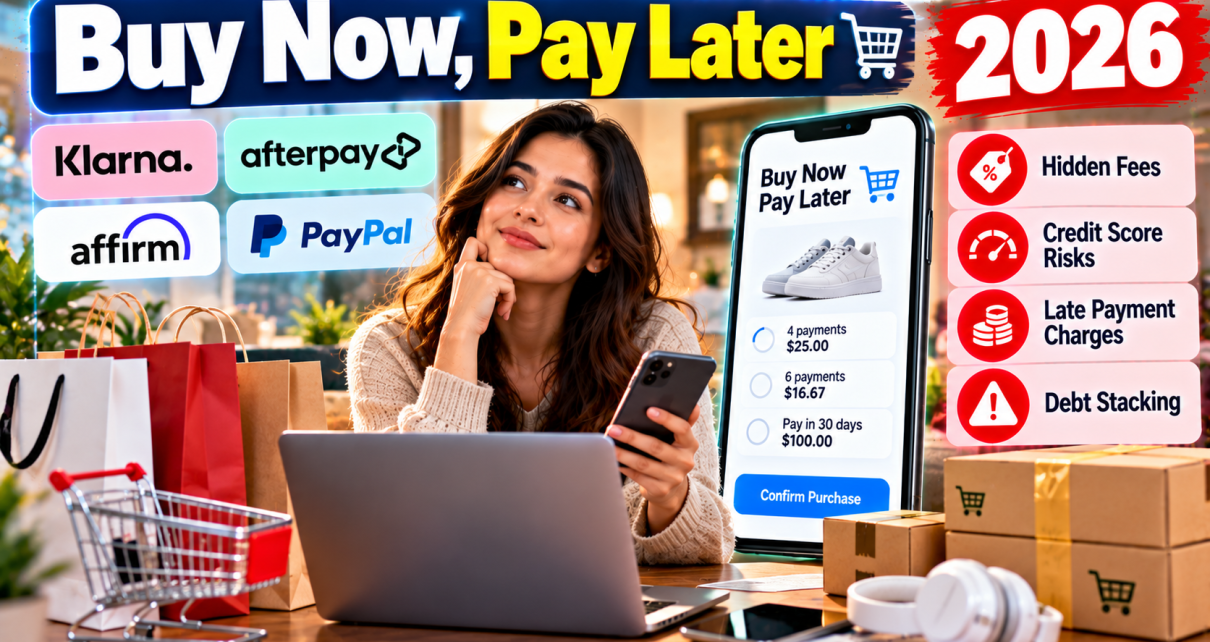
Buy Now, Pay Later in 2026: 9 Hidden Costs and Risks You Should Know
Buy Now, Pay Later can make an expensive purchase look much easier to afford.
Instead of paying $200 at checkout, a shopper might see four payments of $50 spread over several weeks. On the screen, the purchase no longer feels like a $200 expense. It feels like a smaller payment that fits into the next few paychecks.
That convenience is a big reason BNPL has grown so quickly.
But there is another side to the story. Splitting a purchase into installments does not make the purchase cheaper. It changes when the money leaves your account and, depending on the product, who pays the cost of providing the financing.
That is where some of the less obvious risks begin.
BNPL providers can make money in several ways. Some charge merchants for offering BNPL at checkout, while certain products can involve fees for consumers or interest when repayment is extended. Some providers have also moved beyond the traditional four-payment model and into longer-term financing.
For someone considering Buy Now, Pay Later in 2026, the important question is not simply, “Is this payment interest-free?”
The better question is: “What is this purchase actually costing me, and what happens if my financial situation changes?”
Here are nine costs and risks worth understanding before using BNPL.
1. The “Small Payment” Can Hide the Real Cost of the Purchase
One of the biggest psychological advantages of BNPL is also one of its biggest risks.
A product that costs $400 can look much less intimidating when the checkout page presents it as four payments of $100. The total price is still $400, but the smaller installment can make the purchase feel more affordable than it really is.
This matters because affordability and payment size are not the same thing.
Imagine someone has $500 available in their checking account. A $400 purchase paid immediately would be obvious. They would see the money leave their account and would probably think carefully before spending it.
With BNPL, the same person may focus on the first installment instead. If several other BNPL purchases are made during the same period, those future payments can begin stacking up.
The problem is not necessarily the individual transaction. The problem is losing sight of the total amount committed.
This becomes especially important when BNPL is used for ordinary expenses rather than occasional purchases. The source material notes that BNPL has expanded beyond traditional online retail into smaller purchases and even consumable items such as groceries.
A useful rule is simple: before accepting a BNPL plan, look at the total purchase price first and the installment amount second.
2. Late Payments Can Turn a “Free” Loan Into a Costly One
The phrase “interest-free” can create a false sense of security.
Many of the traditional BNPL plans discussed in the source use a pay-in-four structure without interest. But that does not mean every part of the arrangement is free.
The source specifically notes that some providers may charge a fee when a payment is late.
That creates an important distinction:
No interest does not necessarily mean no cost.
If a payment is missed, the consequences depend on the provider and the terms of the particular BNPL product. A consumer therefore needs to look beyond the promotional message shown at checkout.
The risk becomes greater when several installment plans have different payment dates.
A person might remember the purchase but forget the date of the second, third or fourth payment. One missed payment can then create an unexpected expense at exactly the wrong time.
Before using BNPL, check:
– When each payment is due
– Whether late fees apply
– What happens after a missed payment
– Whether the provider restricts future purchases after late payments
– How the provider handles failed payments
Those details can matter more than the “0%” displayed at checkout.
3. Interest Can Appear When You Move Beyond Pay-in-Four
Not every BNPL product follows the classic four-payment model.
The source describes providers offering longer-term loans that can carry interest. It also discusses monthly payment options for larger purchases where simple interest can be attached to the loan.
This is an important development because consumers may associate BNPL with one particular product: four equal payments with no interest.
The wider BNPL market is more complicated than that.
A longer repayment period can make a purchase easier to manage month to month, but it can also mean that the borrower pays more for the financing.
For example, there is a meaningful difference between splitting a purchase into four short payments and taking a longer-term loan that carries interest. The monthly payment may be lower with the longer option, while the total repayment can be higher.
That means shoppers should not stop at the monthly payment.
Look for the total amount that will be repaid.
If interest applies, understand the rate and repayment period before agreeing to the loan.
4. BNPL Can Make Overspending Easier
Credit cards have long faced criticism for making it easier to spend money that a consumer does not currently have.
BNPL can create a similar problem, even though the payment structure looks different.
The source describes BNPL expanding from larger online retail purchases into smaller-ticket transactions and even everyday consumable purchases.
That expansion matters.
If BNPL is used only occasionally for a purchase that has already been budgeted for, the arrangement may be relatively straightforward.
But if it becomes a routine payment method, it can become harder to tell how much money is actually committed.
Someone might have:
One installment for clothing.
Another for electronics.
Another for a household purchase.
Another for groceries.
Each payment may look manageable on its own. Together, they can take a meaningful portion of the next few paychecks.
This is why the number of active BNPL plans matters just as much as the amount of any single purchase.
5. Lower Credit Scores Can Be Part of the Risk Picture
BNPL is often marketed as an alternative way to pay, but it is still a form of borrowing.
That makes the borrower’s ability to repay important.
The source cites a Consumer Financial Protection Bureau study saying that more than two-thirds of BNPL loans went to borrowers with lower credit scores. It also notes that BNPL providers argue that many of their customers are financially strong.
These two observations can exist at the same time.
BNPL can be used by financially responsible consumers, but it can also attract people who have difficulty accessing or using traditional forms of credit.
That creates a risk when someone uses installment financing because they cannot comfortably afford the purchase rather than because the payment structure is genuinely convenient.
A consumer should therefore ask an uncomfortable but useful question:
“If I had to pay the full amount today, would I still buy this?”
If the answer is no, BNPL may be solving an affordability problem rather than simply providing payment flexibility.
6. Multiple BNPL Payments Can Create Cash-Flow Pressure
A payment does not have to be large to cause a problem.
Timing matters.
Suppose a person gets paid twice a month and has several BNPL payments scheduled around the same period. Even if every individual installment is affordable, the combined withdrawals can leave less money available for rent, food, transportation and other bills.
This is particularly relevant for people with irregular income.
A freelancer, seasonal worker or small-business owner may have a strong month followed by a weaker one. A BNPL schedule does not necessarily change simply because income changes.
The source also highlights how BNPL has moved into everyday purchases and smaller transactions. That makes the potential number of simultaneous obligations more important than it was when BNPL was mainly associated with occasional online purchases.
Before using another BNPL plan, add up all existing installment payments.
Do not ask only whether you can afford the next payment.
Ask whether you can afford every payment that will be due during the same period.
7. Credit Reporting Could Change the Long-Term Picture
Credit reporting is another area consumers need to watch.
The source describes changes in how BNPL loans may interact with credit reporting and scoring. It notes that FICO announced plans to add BNPL loans to credit reports, while some providers have taken different positions on when and how customer data should be shared.
This matters because consumers sometimes assume that BNPL operates completely outside the traditional credit system.
That assumption may not remain accurate.
Credit reporting can potentially affect how future lenders view a person’s borrowing history, although the exact impact depends on the reporting and scoring framework being used.
For consumers, the practical lesson is to stop thinking of BNPL as something that automatically exists in a separate financial universe.
Before taking a BNPL loan, check the provider’s current terms and understand whether the product can be reported to credit bureaus and how missed payments may be treated.
The rules and reporting practices can change, so older advice about BNPL should not automatically be treated as current.
8. BNPL Can Encourage Purchases That Would Otherwise Have Been Delayed
There is a difference between spreading the cost of a purchase you already planned and using financing to justify a purchase you would normally postpone.
BNPL can blur that line.
The easier a payment option becomes, the less friction there is between wanting something and buying it.
That is one reason the growth of BNPL is not only about interest rates. It is also about checkout behavior.
The source describes BNPL providers competing for merchant relationships and expanding the types of transactions where their products can be used.
For consumers, wider acceptance means more opportunities to use installment financing.
That can be useful. It can also make it easier to turn wants into monthly or installment obligations.
A good test is to wait before using BNPL for a non-essential purchase.
If the purchase still makes sense after a cooling-off period and the full cost fits comfortably into the budget, the decision is easier to defend.
If the main attraction is simply that the first payment looks small, that is a warning sign.
9. BNPL May Start Looking More Like Traditional Credit
Perhaps the biggest long-term issue is that the boundary between BNPL and traditional credit is becoming less obvious.
The industry began with a relatively simple proposition: divide a purchase into installments, often with no interest.
But BNPL providers have expanded into longer-term loans, monthly payment products and physical cards.
At the same time, regulators and credit-scoring organizations have examined how BNPL should fit into existing financial frameworks. The source describes regulatory debate and changes involving credit reporting.
That means consumers should be careful about treating BNPL as completely different from other forms of borrowing.
It may have a different user experience, but it still involves an obligation to repay money.
The more BNPL products expand, the more important it becomes to compare the actual terms rather than relying on the label attached to the product.
What Should You Check Before Using BNPL?
Before clicking the BNPL option at checkout, take a minute to check the details.
Start with the total purchase price. Then look at the complete repayment schedule.
Check whether the plan has:
– Interest
– Late fees
– Other consumer charges
– A longer repayment period
– Automatic payment requirements
– Credit reporting
– Restrictions after missed payments
Also look at your existing commitments.
If you already have several active installment plans, another “small” payment may not actually be small when added to everything else.
BNPL is generally easier to evaluate when it is being used for a planned purchase that already fits your budget. It becomes much harder to justify when the financing itself is the reason the purchase appears affordable.
BNPL vs. Credit Cards: The Important Difference
It is tempting to say that BNPL is simply replacing credit cards, but the source suggests a more nuanced picture.
One industry executive quoted in the source argues that BNPL may not replace credit cards entirely. Instead, it may replace them for certain people or certain types of transactions.
That distinction is useful.
Consumers do not necessarily have to choose one payment method forever.
The better approach is to understand what each option costs and how it fits into the overall budget.
A credit card can provide convenience and, depending on the terms and repayment behavior, may avoid interest when the balance is paid in full. BNPL can divide a purchase into scheduled installments, but different BNPL products can have different fees, interest arrangements and reporting practices.
The payment method should not determine whether you can afford the purchase.
Your budget should determine that first.
Final Thoughts
Buy Now, Pay Later in 2026 is no longer just a simple “four payments, no interest” checkout feature.
The industry has expanded into different loan structures, larger purchases, physical cards and more everyday transactions. At the same time, questions around late payments, consumer losses, credit reporting and regulation have made the product more complicated than it may appear on a checkout screen.
The biggest hidden cost may not always be a fee.
Sometimes it is the loss of perspective.
A $50 installment can feel easier than a $200 purchase, but your bank account ultimately has to deal with the full financial commitment. If several installment plans overlap, the problem can become even harder to see.
That does not mean BNPL is automatically a bad financial product.
It means consumers should treat it as borrowing rather than as a discount.
Before using Buy Now, Pay Later, look at the total cost, understand the repayment schedule, check what happens if you pay late, and consider whether the purchase would still fit your budget without the smaller installment presentation.
If the answer is yes, BNPL may simply be a payment option.
If the answer is no, the payment plan may be making an unaffordable purchase look affordable.
