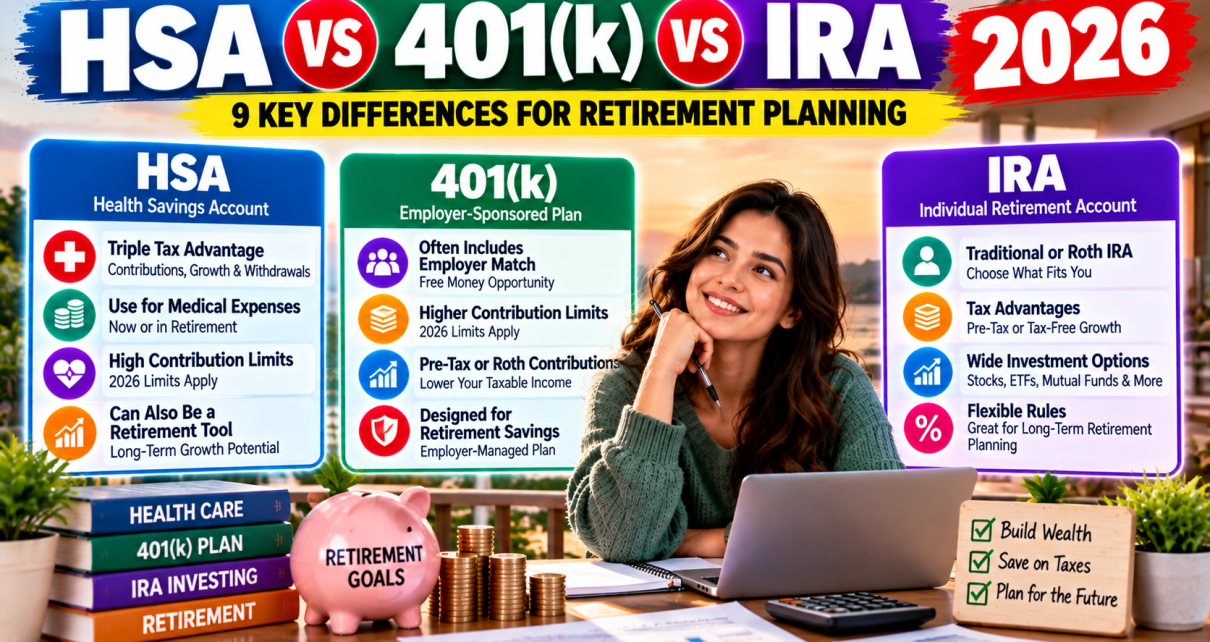
HSA vs 401(k) vs IRA 2026: 9 Key Differences for Retirement Planning
Choosing where to put your retirement savings can be confusing.
You may hear about 401(k) plans through your employer, traditional IRAs, Roth IRAs, and Health Savings Accounts, or HSAs. All of these accounts can play an important role in a financial plan, but they do not work in exactly the same way.
The biggest differences involve taxes, contribution rules, employer benefits, investment options, withdrawal rules, and the purpose of each account.
A 401(k) is primarily an employer-sponsored retirement account. An IRA is an individual retirement account that you generally open yourself. An HSA is designed specifically for qualified medical expenses, although its tax advantages can also make it relevant to long-term retirement planning.
Understanding these differences is important because choosing the right account can affect how efficiently your money grows and how much flexibility you have later.
Here are nine key differences to understand before deciding how to prioritize an HSA, 401(k), or IRA in 2026.
- The Main Purpose of Each Account Is Different
The first difference is the reason each account exists.
A 401(k) is primarily designed to help employees save for retirement through an employer-sponsored plan.
An IRA is an individual retirement account designed to help people save and invest for retirement outside of an employer-sponsored plan.
An HSA is different.
A Health Savings Account is specifically designed to help eligible individuals save for qualified medical expenses. However, its tax treatment can make it particularly interesting as part of a long-term financial plan.
The source describes the HSA as the only account among the accounts discussed with a triple tax advantage: contributions can receive tax advantages, investment growth can be tax-free, and withdrawals can be tax-free when used for qualified medical expenses.
This creates an important distinction.
If you are deciding between accounts, you should first understand what each account is designed to accomplish.
A 401(k) is primarily for retirement.
An IRA is primarily for retirement.
An HSA is primarily for qualified healthcare expenses, but can potentially serve a secondary retirement-planning role.
Because the accounts have different purposes, there is no universal answer that says one should replace the others.
- Employer Matching Can Make a 401(k) Especially Important
One of the biggest advantages a 401(k) can provide is an employer contribution or matching program.
If your employer offers a 401(k) match, the source emphasizes taking advantage of it rather than leaving that benefit unused.
An employer match can effectively add money to your retirement savings based on your own contributions, subject to your employer’s specific plan rules.
This is different from an IRA or HSA because the employer match is connected to your workplace retirement plan.
For example, suppose an employer says it will contribute a certain amount based on what you put into your 401(k).
If you contribute enough to receive the full available match, you are taking advantage of a benefit that is not generally available simply by opening an IRA on your own.
This makes it important to understand your employer’s plan before deciding where every retirement dollar should go.
Look at:
The employer match formula
The contribution percentage required to receive the match
Vesting rules
Investment options
Plan fees
Your own contribution amount
A 401(k) can therefore be particularly valuable when the employer provides matching contributions.
However, once the available employer match has been considered, the comparison between a 401(k), IRA, and HSA becomes more nuanced.
- Traditional Accounts Provide Tax Benefits at Different Stages
Traditional 401(k)s and traditional IRAs generally follow the same basic tax concept.
You may receive a tax benefit for eligible contributions today, the money can grow within the account, and withdrawals are generally taxable later.
The source describes this as receiving a tax break upfront and paying taxes when the money is withdrawn.
This can be useful for someone who wants to reduce taxable income during their working years.
The basic idea is:
Contribute eligible money.
Receive the applicable tax treatment.
Allow investments to grow.
Pay applicable taxes when money is withdrawn.
However, the tax rules are more complicated than this simplified description, and eligibility for IRA deductions can depend on factors such as income and participation in an employer retirement plan.
The important concept is that traditional retirement accounts generally move the tax benefit toward the present while leaving taxation for later.
That can make them attractive to people who value a tax deduction today.
But it also means you need to think about your future tax situation.
- Roth Accounts Reverse the Basic Tax Timing
Roth accounts work differently.
With a Roth IRA or Roth 401(k), contributions are generally made with money that has already been taxed.
In exchange for giving up the upfront tax deduction, qualified withdrawals can generally be tax-free.
The source describes the Roth structure as paying taxes upfront and then allowing future qualified growth and withdrawals to be tax-free.
This creates a different retirement-planning decision.
Traditional:
Potential tax benefit today, taxation later.
Roth:
Taxes paid today, potential tax-free qualified withdrawals later.
Neither structure is automatically appropriate for every person.
The choice can depend on your current tax situation, expected future tax situation, income, eligibility, and retirement goals.
A Roth IRA also has a feature that can provide additional flexibility: the source notes that original contributions can generally be withdrawn without tax and penalty, while investment earnings have additional rules.
However, Roth withdrawal rules are detailed, and taxpayers should distinguish between withdrawing contributions and taking distributions of earnings.
The key lesson is that tax timing matters.
You are essentially choosing when you want to receive the primary tax advantage.
- An HSA Has a Unique Triple Tax Advantage
The HSA stands apart from both the 401(k) and IRA because it combines healthcare savings with significant tax advantages.
The source describes the HSA as the only account among the accounts discussed with a triple tax advantage.
Money can go into the HSA with tax advantages.
The money can potentially grow without current taxation.
And withdrawals used for qualified medical expenses can be tax-free.
That combination can make an HSA particularly valuable for someone who is eligible to contribute.
But there is an important requirement.
You generally need to be covered by an eligible high-deductible health plan to contribute to an HSA.
This means an HSA is not simply another retirement account that everyone can open regardless of their health insurance arrangement.
Eligibility matters.
If you are eligible, however, an HSA can serve two financial purposes.
First, it can help you prepare for current or future healthcare expenses.
Second, if you have the financial capacity to pay current medical expenses from other funds and leave the HSA invested, the account can potentially grow for future healthcare costs.
The source specifically discusses the strategy of paying qualified medical expenses out of pocket, keeping receipts, and potentially reimbursing yourself years later.
That strategy requires careful recordkeeping and adherence to applicable rules.
- HSA Withdrawals After Age 65 Work Differently
Another important HSA feature appears when you reach age 65.
The source explains that after age 65, HSA funds can be used for non-medical expenses without the additional 10% penalty that generally applies to earlier non-qualified withdrawals. However, non-medical withdrawals are generally taxable, similar to traditional retirement-account withdrawals.
This creates an unusual characteristic.
If you use HSA money for qualified medical expenses, the withdrawal can retain the HSA’s tax-free treatment.
If you use it for non-qualified expenses after age 65, the money can generally be withdrawn without the additional 10% penalty but may be subject to ordinary income tax.
That means the HSA can potentially function as both:
A healthcare savings account
A supplemental retirement account
However, its healthcare purpose should not be overlooked.
Medical expenses can become significant during retirement, and using HSA funds for qualified medical expenses can preserve the account’s full tax advantages.
For retirement planning, this makes an HSA different from a traditional IRA or 401(k).
The HSA can provide a dedicated pool of money for healthcare while also offering additional flexibility later in life.
- Contribution Limits and Eligibility Are Different
Another major difference is how much you can contribute and who can contribute.
The specific annual limits change over time, so taxpayers should use the current IRS limits for the relevant tax year rather than relying on old figures.
The source itself uses 2025 contribution figures when explaining the accounts, which means those numbers should not be treated as 2026 limits.
The broader distinction remains important.
A 401(k) has an employer-sponsored contribution structure.
An IRA has its own annual contribution limit and eligibility requirements.
An HSA has separate contribution limits and requires qualifying health coverage.
These limits mean you cannot simply move unlimited money into whichever account offers the most attractive tax treatment.
Your eligibility and available contribution room determine what you can actually use.
For 2026 planning, check the current IRS contribution limits for:
Traditional 401(k)
Roth 401(k)
Traditional IRA
Roth IRA
HSA
You should also check whether your income, employer plan, health insurance coverage, or other circumstances affect your eligibility.
- Investment Options and Account Flexibility Can Differ
Another difference involves how you actually invest the money.
A 401(k) is controlled by an employer-sponsored plan, so the investment menu depends on the options selected by the plan.
An IRA is generally opened individually, giving you access to the investment choices offered by the brokerage or financial institution where you hold the account.
An HSA can also offer investment options, depending on the provider and plan.
This means the account itself does not tell you everything about the investment experience.
Two people can have 401(k) accounts with very different investment choices because their employers use different plan providers.
Similarly, different IRA and HSA providers can offer different investment options and fees.
When evaluating an account, consider:
Available investments
Account fees
Investment expenses
Ease of managing the account
Automatic contribution options
Employer matching, if applicable
The ability to transfer or roll over assets under the applicable rules
For a long-term retirement strategy, the account’s tax advantages matter, but the investment options and costs also matter.
A tax-advantaged account with poor investment choices or high costs may require closer evaluation.
- Withdrawal Rules and Retirement Planning Are Different
Finally, the withdrawal rules are different across these accounts.
Traditional 401(k)s and traditional IRAs generally impose taxes on withdrawals, and taking money out before the applicable retirement age can result in an additional penalty unless an exception applies.
The source uses age 59½ as the general benchmark for avoiding the early-withdrawal penalty, while also noting that exceptions can exist.
Roth accounts have different rules, particularly regarding contributions versus investment earnings.
An HSA has another completely different structure because qualified medical withdrawals can remain tax-free.
These differences matter when building a retirement strategy.
You do not want all of your retirement money subject to exactly the same tax treatment and withdrawal restrictions if diversification of tax treatment would be useful for your circumstances.
Having a combination of account types can provide different sources of money during retirement.
For example, someone might have:
Traditional 401(k) savings
Roth IRA savings
HSA savings
Taxable brokerage investments
Cash reserves
Each account can serve a different role.
The goal is not necessarily to maximize one account in isolation.
The goal is to build a retirement system that gives you appropriate access to money while considering taxes, investment growth, healthcare expenses, and your financial goals.
HSA vs 401(k) vs IRA: Simple Comparison
The three accounts can be thought of this way.
A 401(k) is primarily an employer-sponsored retirement account.
A traditional IRA is an individual retirement account that can provide potential tax benefits today with taxation generally occurring on withdrawals later.
A Roth IRA generally uses after-tax contributions and can provide tax-free qualified withdrawals.
An HSA is designed for qualified healthcare expenses and can provide a unique triple tax advantage for eligible participants.
A 401(k) may provide employer matching.
An IRA generally provides greater individual control over the account and investment provider.
An HSA requires qualifying health coverage.
The accounts also have different contribution limits, investment options, and withdrawal rules.
How to Think About the Priority of These Accounts
The source provides a general order of operations for allocating money across different account types.
It starts with building an emergency fund.
Then it emphasizes taking advantage of an employer 401(k), particularly when an employer match is available.
After that, it discusses using a Roth IRA for long-term growth.
If eligible, an HSA can then become another tax-advantaged account.
Finally, a taxable brokerage account can be used for additional investing after tax-advantaged accounts are being used.
This should be viewed as a framework rather than a universal prescription.
Your personal circumstances can change the appropriate order.
For example, someone carrying expensive debt may have different priorities from someone with no debt and a substantial emergency fund.
Someone who is not eligible for an HSA cannot simply add one to the strategy.
Someone whose employer provides a significant 401(k) match may place greater emphasis on that benefit.
The important idea is to think about accounts as tools.
Each tool has a specific purpose.
Common Mistakes to Avoid
One common mistake is ignoring an employer 401(k) match.
If your employer offers matching contributions and you do not contribute enough to receive the available match, you may be missing part of your workplace benefits.
Another mistake is treating an HSA as simply another checking account for medical bills.
While an HSA can be used for qualified medical expenses, its long-term tax advantages may make it worth considering as part of broader financial planning for eligible individuals.
A third mistake is choosing traditional or Roth accounts without thinking about tax timing.
The difference between receiving a tax benefit today and potentially receiving tax-free qualified withdrawals later can be significant.
Another mistake is ignoring contribution limits.
Tax-advantaged accounts have rules that limit how much you can contribute.
Finally, avoid assuming that an account is automatically good simply because it is tax-advantaged.
Fees, investment choices, employer matching, eligibility requirements, and withdrawal rules all matter.
The account should fit the job you want it to perform.
Building a Diversified Retirement Strategy
Retirement planning does not necessarily require choosing one account and ignoring everything else.
In many cases, different account types can complement one another.
A 401(k) can provide workplace retirement savings and potentially employer matching.
A traditional IRA can provide another retirement savings vehicle with its own tax rules.
A Roth IRA can provide tax diversification by creating a source of potentially tax-free qualified retirement income.
An HSA can create a dedicated source of tax-advantaged healthcare savings.
A taxable brokerage account can provide additional flexibility for goals that do not fit neatly into retirement accounts.
A high-yield savings account can provide liquidity for emergencies and short-term needs.
The source emphasizes this broader account-based approach by describing multiple account types and different roles they can play.
This is useful because retirement is not just about accumulating the largest possible account balance.
It is also about having the right type of money available at the right time.
Final Thoughts
HSA vs 401(k) vs IRA is not really a question of which account is universally better.
Each account solves a different financial problem.
A 401(k) can provide powerful retirement-saving opportunities through an employer plan, especially when matching contributions are available.
A traditional IRA can provide potential tax benefits today while generally deferring taxation until retirement withdrawals.
A Roth IRA takes the opposite approach by using after-tax contributions in exchange for potentially tax-free qualified withdrawals.
An HSA is different from all of them because it is designed around healthcare expenses and can provide a unique triple tax advantage for eligible individuals.
The nine key differences to remember are:
The primary purpose of each account
Employer matching opportunities
When you receive the main tax benefit
Traditional versus Roth tax treatment
The HSA’s triple tax advantage
HSA rules after age 65
Contribution limits and eligibility
Investment choices and account flexibility
Withdrawal rules and retirement access
The most effective retirement strategy is rarely about finding one magical account.
Instead, it is about understanding how different accounts work and using the ones for which you qualify in a way that matches your income, taxes, employer benefits, healthcare coverage, retirement goals, and financial timeline.
Before making contribution decisions for 2026, verify the current IRS limits and rules for the specific tax year. Account rules can change, and eligibility can depend on circumstances that are not obvious from the account name alone.
The better you understand the differences between an HSA, 401(k), and IRA, the easier it becomes to build a retirement plan that is structured around your actual financial needs rather than simply following a one-size-fits-all formula.
