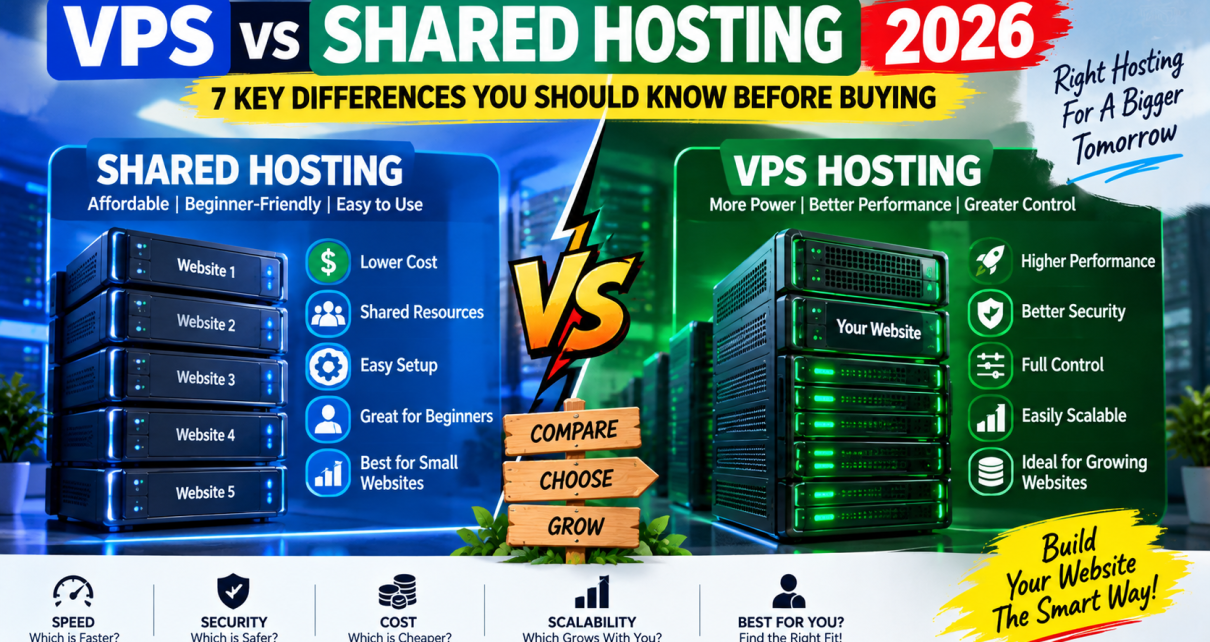
VPS vs Shared Hosting 2026: 7 Key Differences You Should Know Before Buying
Choosing the right web hosting can have a major impact on your website’s performance, security, flexibility, and long-term growth. For many website owners, the decision eventually comes down to two popular options: VPS hosting and shared hosting.
At first glance, both options may appear similar because they perform the same basic job. They provide the server environment needed to make a website accessible online, and both can support popular technologies such as WordPress, PHP, and databases.
The major difference is how the underlying server resources are allocated and how much control you have over the hosting environment.
Shared hosting places multiple websites on the same physical server and requires them to share the available resources. VPS hosting, on the other hand, creates a separate virtual server environment within a physical machine. This gives your website greater control, more flexibility, and generally more predictable access to resources.
Neither option is automatically suitable for every website. Shared hosting can be practical for smaller websites and beginners, while VPS hosting can become more useful as a website grows and requires additional resources or customization.
Before buying a hosting plan in 2026, understanding these differences can help you avoid paying for resources you do not need or choosing a hosting environment that becomes too restrictive later.
Here are seven key differences between VPS hosting and shared hosting that you should understand before making your decision.
- How VPS Hosting and Shared Hosting Work
The first major difference is the way websites use the server.
With shared hosting, several websites are hosted on the same physical server. The websites share the server’s available resources and operate within the limitations established by the hosting provider.
Think of shared hosting like living in a building where several residents use the same infrastructure. You have your own space for your website, but the underlying resources are shared with other users.
This arrangement allows hosting providers to offer shared hosting at relatively low prices. It is one of the reasons shared hosting has traditionally been popular among beginners, small businesses, bloggers, and people creating their first websites.
VPS hosting works differently.
A VPS, or Virtual Private Server, uses virtualization technology to divide a physical server into separate virtual environments. Each VPS operates as its own virtual server with its own allocated environment.
Instead of simply sharing the same hosting environment with many other websites, your website receives a more isolated virtual environment.
The important point is that both hosting types perform the same basic function: they make websites available online. Both can support technologies such as WordPress, PHP, and databases, and hosting companies can offer both services from the same platform.
The difference is primarily in how the server environment is divided, managed, and controlled.
This means that moving from shared hosting to VPS hosting does not necessarily mean changing everything about how you run your website. In some cases, a hosting provider can allow customers to upgrade between hosting types as their requirements change.
- Resource Sharing and Website Usage
The second difference is how resources are used.
Shared hosting is designed around the idea that multiple websites can operate on the same server while sharing its resources. This makes sense when individual websites do not require substantial server resources.
For example, imagine that you are launching a small personal blog with a limited amount of content and relatively modest traffic.
Buying a powerful private server environment for such a project may not make practical sense.
Shared hosting can provide the basic environment needed to publish the website without requiring you to manage a more complicated server.
This is one reason shared hosting is generally associated with smaller projects.
VPS hosting becomes more relevant when a website grows or requires more resources and flexibility.
A growing website may eventually need more processing power, memory, storage, or control over its server environment. It may also require software configurations that are not available within a restrictive shared hosting environment.
In that situation, VPS hosting can provide a more adaptable platform.
A useful way to think about the difference is simple:
Shared hosting is generally designed for websites that can comfortably operate within a shared environment.
VPS hosting is designed for websites that have grown beyond the limitations of that environment or need greater control.
This does not mean every growing website immediately needs a VPS. The actual requirement depends on the website, its workload, software requirements, traffic patterns, and hosting configuration.
The important thing is to understand that VPS hosting provides a different level of resource control and flexibility rather than simply being a more expensive version of shared hosting.
- Price: Is VPS Hosting Really Much More Expensive?
Price is one of the first things people consider when comparing VPS hosting and shared hosting.
At first, it may seem obvious that VPS hosting should cost significantly more because it provides a more advanced server environment.
In general, shared hosting is positioned as the lower-cost option, while VPS hosting can cost more because of the additional resources and control it provides.
However, the actual price difference depends heavily on the hosting provider, plan configuration, promotional pricing, renewal pricing, and whether the VPS is managed or unmanaged.
Some hosting companies offer relatively affordable VPS plans, meaning the price gap between entry-level shared hosting and entry-level VPS hosting may not always be as large as beginners expect.
But price should not be the only factor.
An inexpensive unmanaged VPS may require substantially more technical work from the website owner. If you do not have the knowledge required to manage a server, the lower monthly price may not represent the true cost of operating the website.
You may need to deal with server configuration, security updates, firewall configuration, software installation, optimization, and other technical responsibilities.
Shared hosting generally handles much of this server-side management for you.
Therefore, when comparing prices, consider both the monthly hosting cost and the amount of technical responsibility associated with the plan.
A cheaper server is not necessarily the cheaper solution if it requires skills, time, or additional services that you do not currently have.
- Managed VPS vs Unmanaged VPS
One of the most important differences to understand before purchasing VPS hosting is the distinction between managed and unmanaged VPS hosting.
This distinction can completely change the experience of using a VPS.
With an unmanaged VPS, you are generally responsible for managing the server environment yourself.
That can include tasks such as server optimization, security updates, firewall configuration, software installation, and other technical administration.
This provides considerable control, but it also requires technical knowledge.
For someone who understands server administration, an unmanaged VPS can provide a high level of flexibility. You have greater responsibility, but you also have more control over how the environment is configured.
For a beginner, however, this can create a steep learning curve.
Managed VPS hosting takes a different approach.
With managed VPS hosting, the hosting provider or its technical team handles many of the server-management responsibilities. This can make VPS hosting easier to operate because you do not have to handle every technical task yourself.
The additional management generally comes at a higher cost.
This creates an important trade-off:
Unmanaged VPS:
More responsibility, greater technical involvement, and potentially lower hosting costs.
Managed VPS:
Less technical responsibility, additional provider support, and potentially higher costs.
Shared hosting is generally much closer to the managed experience because the hosting company handles the underlying server environment.
You can still install applications, configure your website, improve content, and add additional security measures where supported, but you generally do not need to manage the entire server yourself.
This is an important consideration for beginners.
If you are attracted to VPS hosting because of its performance and flexibility but do not have experience managing Linux servers or server security, you should carefully consider whether managed VPS hosting is more appropriate for your situation.
- Customization and Control
Customization is another major difference between VPS hosting and shared hosting.
Shared hosting environments are designed to support many customers on the same physical infrastructure. Because multiple websites depend on the same server environment, hosting providers need to establish certain limitations and restrictions.
These restrictions help the provider maintain a stable hosting environment for everyone.
However, they can become frustrating when a website has more advanced requirements.
A VPS provides a much more customizable environment.
Because the VPS operates as a separate virtual server environment, users generally have greater control over server configuration, software, security settings, and other technical components.
This can be particularly useful for developers and businesses that need specific server configurations.
For example, a project may require particular software, a custom configuration, or server-level changes that are not possible on a standard shared hosting account.
A VPS gives the website owner considerably more room to adapt the server environment to those requirements.
This flexibility becomes increasingly important as projects become more complex.
However, customization also creates responsibility.
Having more control means there are more settings that can be changed incorrectly. Poor configuration can create security problems, performance issues, or compatibility problems.
Therefore, VPS customization is most valuable when the website owner or technical team knows how to use that additional control properly.
- Scalability and Website Growth
Another important difference is how well the hosting environment can adapt as your website grows.
When you launch a new website, your requirements may be relatively small.
You may only need basic WordPress hosting, a database, an SSL certificate, backups, and enough resources to handle your initial visitors.
Shared hosting can be suitable for this type of project.
But websites rarely remain exactly the same forever.
A blog can grow from a few articles to hundreds of pages. An online business can attract more visitors. A content website can increase its publishing frequency. A web application can develop more demanding technical requirements.
As these changes occur, the hosting environment may also need to change.
Shared hosting can become restrictive for larger or more resource-intensive projects because you continue operating within the limitations of a shared environment.
VPS hosting provides greater flexibility for these situations.
You can move into a virtual server environment with more resources and greater customization options.
This is one reason upgrading from shared hosting to VPS hosting can be a logical progression for some websites.
The key advantage is not simply that VPS hosting is more powerful. It is that the environment can be adapted more easily when your website’s technical requirements change.
Some hosting providers also offer both shared hosting and VPS hosting, allowing customers to remain within the same hosting ecosystem while upgrading their plan.
That can simplify the transition because you may not need to move to an entirely different hosting company.
However, the exact migration process depends on the provider and hosting plans involved, so you should always check the specific migration and upgrade options before purchasing.
- Ease of Use and Technical Knowledge
The final difference is the amount of technical knowledge required.
For beginners, shared hosting is generally easier to understand and operate because much of the server management is handled by the hosting provider.
You can focus on the website itself rather than spending your time maintaining the underlying server.
For example, if you are creating a small business website, personal blog, portfolio, or basic WordPress site, you may prefer an environment where the hosting company handles most server-level responsibilities.
VPS hosting is different.
An unmanaged VPS can require considerably more technical knowledge.
You may need to understand server operating systems, security updates, firewall configuration, software packages, permissions, backups, optimization, and other server-management tasks.
That does not make VPS hosting unsuitable for beginners in every situation. It simply means that the type of VPS plan matters.
A managed VPS can reduce the technical burden by allowing the provider to handle many of the administrative responsibilities.
Some hosting providers have also introduced tools designed to make VPS management easier, including AI-powered assistants and automated server-management features.
According to the source material, one example is Hostinger’s Cody chatbot, which is presented as a tool that can assist with technical server tasks such as SSL installation. These tools can make server management more accessible, although users should still understand what their hosting plan actually includes before relying on automation.
The important lesson is that you should choose a hosting environment based not only on your website’s requirements but also on your own technical ability.
VPS vs Shared Hosting: Quick Comparison
The difference becomes easier to understand when the two options are viewed side by side.
Shared Hosting
Shared hosting places multiple websites on the same physical server and provides a simpler hosting environment.
It is generally suitable for:
Small websites
New blogs
Personal websites
Basic WordPress projects
Small business websites
Beginners with limited technical knowledge
Projects with relatively modest resource requirements
Its main advantages are simplicity, affordability, and reduced server-management responsibility.
Its main limitation is that customization and resource flexibility can be more restricted.
VPS Hosting
VPS hosting provides a separate virtual server environment within a physical server.
It is generally more suitable for:
Growing websites
More demanding projects
Developers
Web applications
Businesses requiring greater control
Projects needing additional customization
Website owners comfortable with server management
Its main advantages are greater control, customization, scalability, and a more isolated virtual environment.
Its main limitation is that unmanaged VPS hosting can require significant technical knowledge and maintenance.
When Should You Choose Shared Hosting?
Shared hosting can make sense when your website is still relatively small and your priority is simplicity.
If you are launching your first website, you may not need the additional complexity of a VPS.
For example, a new blog with a limited audience does not necessarily need a highly customizable server environment.
The same can apply to a basic portfolio website or a small informational business website.
In these situations, shared hosting can provide the basic infrastructure required to get online while allowing you to focus on creating content and managing your website.
Another reason to choose shared hosting is that it gives you time to learn.
You can become familiar with WordPress, website administration, domains, SSL certificates, backups, security, and other aspects of running a website without immediately taking responsibility for server administration.
If your website eventually outgrows the shared environment, you can consider upgrading at that point.
When Should You Consider VPS Hosting?
VPS hosting becomes more relevant when your website requires greater control or has outgrown the limitations of shared hosting.
You may want to consider a VPS when you need more customization, specific server configurations, additional resources, or greater control over the hosting environment.
It can also make sense when you are running a more technically demanding application or project.
However, upgrading to VPS hosting should not be based purely on the idea that VPS is automatically better.
If your website does not need the additional resources or customization, paying for a more advanced hosting environment may simply add complexity without providing a meaningful benefit.
Similarly, buying an unmanaged VPS without understanding how to manage it can create unnecessary technical challenges.
The source itself illustrates this issue by describing a situation where upgrading to a VPS without enough knowledge led to moving back to shared hosting until more technical knowledge was gained.
That is an important lesson for anyone considering VPS hosting.
Choose the environment you can actually manage effectively rather than choosing based only on specifications.
Can You Start With Shared Hosting and Upgrade Later?
Yes, this can be a practical approach when your hosting provider supports an upgrade path.
Starting with shared hosting allows you to build your website without immediately taking on the complexity of VPS administration.
As your website develops, you can evaluate whether your current hosting environment is still meeting your requirements.
If it is no longer sufficient, you can consider moving to a VPS.
The source specifically describes a hosting provider offering both shared hosting and VPS options, allowing customers to upgrade between the two without necessarily changing providers.
This type of upgrade path can be useful because it allows your hosting environment to evolve with your website.
However, before buying a shared hosting plan, check whether the provider offers a straightforward VPS upgrade option, what migration assistance is available, and whether your website can be moved without significant downtime.
What About Security?
Security is another reason people consider VPS hosting, but it is important to understand the difference between having more control and automatically being more secure.
A VPS can provide a more isolated and customizable environment, but an unmanaged VPS also puts more security responsibility on the user.
You may be responsible for security updates, firewall configuration, server software, permissions, and other technical controls.
If these tasks are neglected or configured incorrectly, the additional control does not automatically translate into better security.
Shared hosting, meanwhile, places much of the server-level responsibility with the hosting provider.
This can be easier for beginners because the provider manages the underlying infrastructure.
Both hosting types can also offer common hosting features such as SSL certificates, backups, firewalls, and control panels, depending on the specific plan.
Therefore, when evaluating security, look beyond the hosting label.
Check what security features are included, who manages them, how backups are handled, and what responsibilities remain with you.
The Right Choice Depends on Your Website
There is no universal hosting plan that is right for every website.
The better question is not simply, “Which is more powerful?”
Instead, ask:
How large is my website?
How much traffic and resource usage does it require?
Do I need custom server configurations?
How much technical knowledge do I have?
Do I want to manage the server myself?
Does my website need to scale?
How much am I willing to spend?
Would managed hosting save me time?
These questions provide a much clearer way to compare VPS hosting and shared hosting.
For a small website, shared hosting can provide the simplicity and affordability needed to get started.
For a growing or technically demanding project, VPS hosting can provide the additional control and flexibility that a shared environment may not offer.
The biggest mistake is choosing a hosting plan based purely on specifications or price without considering how you will actually use it.
Final Thoughts
The difference between VPS hosting and shared hosting comes down to much more than price.
Both hosting types perform the same fundamental job: they provide the infrastructure needed to put your website online. Both can support technologies such as WordPress, PHP, and databases, and both can provide common hosting features.
The major differences involve resource sharing, control, customization, technical responsibility, scalability, and ease of use.
Shared hosting is generally designed around simplicity. You share the underlying server environment with other websites, while the hosting provider manages much of the technical infrastructure.
VPS hosting provides a more independent virtual environment with greater control and customization. However, especially with an unmanaged VPS, that additional control also comes with additional responsibility.
For a beginner or a small website, starting with shared hosting can be a practical way to keep things simple. If the website eventually grows or requires greater customization, upgrading to VPS hosting may provide a more flexible environment.
If you are considering VPS hosting, pay particular attention to whether the plan is managed or unmanaged. A low-cost unmanaged VPS may require considerably more technical knowledge than a shared hosting plan.
Ultimately, the right hosting choice should match your current website requirements, technical skills, budget, and expected growth.
Do not pay for server resources and complexity that you do not need, but do not ignore future requirements if your website is already growing.
Understanding these seven differences before buying can help you choose a hosting environment that fits your project today while giving you a clearer path for the future.